
Please Choose Your Language


Views: 0 Author: Site Editor Publish Time: 2026-10-21 Origin: Site


Imagine walking your fields mid-season. Instead of a lush, uniform canopy, you spot distinct striped patterns. Vibrant green alternating with stunted, pale yellow. This uneven nutrient distribution ruins more than just the aesthetic of your farm. It actively drains your wallet and suppresses overall yield.
Many growers immediately blame their spreader settings or the chemical formulation. Yet, the hidden culprit behind this frustrating issue is often much simpler: inconsistent fertilizer granule size. Understanding exactly how physical properties dictate the fate of your nutrients is the very first step toward flawless field application.
Applying dry nutrients through a mechanical broadcast spreader is essentially an exercise in ballistics. Modern spreaders use high-speed spinning discs equipped with fins to project particles using centrifugal force. Once a particle leaves that spinner, its mid-air flight path relies on mass, velocity, aerodynamic drag, and initial launch angle.
In this dynamic environment, size acts as the primary variable. Basic physics dictates that larger, heavier granules carry greater kinetic energy. This physical advantage allows them to punch right through air resistance, traveling significantly further from the back of the tractor. Smaller, lighter particles lack that necessary momentum. They decelerate rapidly due to drag and fall immediately behind the equipment. Or worse, they drift off-target with the slightest breeze.
Load a batch containing a wide, erratic variance in sizes, and your spreader will inherently sort the material mid-air. Larger particles consistently land at the outer edges of the swath. Fine dust concentrates in a heavy band directly behind the machine. This ballistic sorting completely ruins uniformity, creating localized zones of toxicity side-by-side with severe deficiency.
Beyond simple dimensions, size operates in tandem with bulk density and crush strength. Bulk density measures the weight of the material per unit volume. Two granules of the exact same size but differing densities will carry different masses, resulting in entirely different spread widths.
Furthermore, crush strength is a critical survival metric during the spreading process. Picture the journey of a single particle dropping from the hopper gate directly onto high-speed steel spinner fins rotating at 800 RPM. It endures massive mechanical impact. If the particles are too soft, this violent impact shatters them into smaller fragments and dust before they even leave the machine. This mid-air fragmentation instantly alters the trajectory and severely compromises application uniformity. Premium manufacturing ensures adequate crush strength to withstand aggressive handling without degrading.
Recent agronomic market analyses reveal a massive shift in how we approach dry applications. With the rapid adoption of Variable Rate Technology and high-clearance spreaders pushing 90 to 120-foot swaths, industry expectations have fundamentally changed. Ten years ago, a slight variation in sizing might have been overlooked on a narrow 40-foot spread pattern. Today, precision agriculture demands flawless physical inputs.
If the physical properties are inconsistent, expensive digital prescriptions mapped by agronomists become entirely useless. The software might command a specific rate change at a GPS coordinate, but if the machine throws unpredictable granules, those nutrients will never land where the software dictates. Climate-smart farming initiatives also heavily emphasize reducing volatilization and runoff. Consequently, major distributors now demand stricter physical quality control from manufacturers, elevating granule uniformity from a simple preference to an absolute operational necessity.
Fertilizer segregation is the physical separation of different nutrient components during handling, transport, and application. This phenomenon is almost entirely driven by mismatched physical properties among the raw materials.
In agricultural logistics, operators often call this kinematic sifting. Picture a tender truck bouncing down a rutted gravel road. Continuous vibration forces smaller particles to filter downward through microscopic gaps between larger ones. The smaller granules settle at the absolute bottom of the hopper, while larger ones rise to the top. When you engage the PTO and begin spreading, the chemical composition exiting the gate changes continuously from the start of the field to the end.
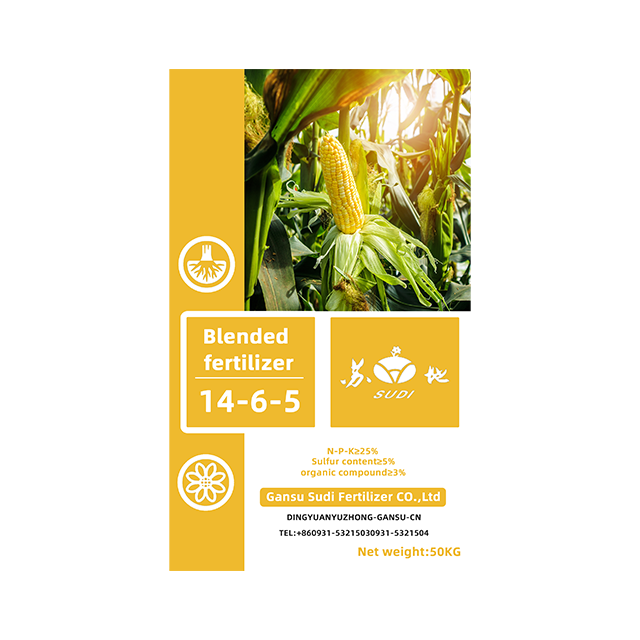
To put this agronomic risk into perspective, consider the precise application of a 14-6-5 bulk blending fertilizer. This specific formulation delivers Nitrogen, Phosphorus, and Potassium to the root zone in that exact ratio. However, if the urea providing the nitrogen is significantly larger than the potash providing the potassium, severe segregation is inevitable.
During application, spinning discs throw heavy nitrogen far out into the swath, while smaller potassium drops near the center line. One section gets a massive excess of nitrogen, while the adjacent strip gets too much potassium. To prevent this, premium formulations maintain a strict Size Guide Number variance, ensuring all raw materials within the blend match perfectly.
When addressing chronic segregation challenges, your input's manufacturing method plays a pivotal role. A high-quality compound fertilizer is produced through an advanced chemical granulation process. Raw nutrient materials are melted or slurried together, then granulated as a unified product.
The defining characteristic here is that every single particle contains the exact target ratio of nutrients. Because each piece is chemically identical, the risk of nutrient segregation vanishes entirely. Even if slight variations in size exist within the hopper, the NPK ratio applied to the soil remains perfectly uniform. The larger pieces flying 40 feet away deposit the exact same ratio as the smaller ones landing 10 feet away.
On the flip side, custom granular NPK fertilizer blends offer incredible agronomic flexibility. Crop consultants can tailor ratios based on highly specific soil grid samples. Historically, blends struggled with field uniformity compared to compound options. Today, modern manufacturing and screening technologies have drastically closed that gap.
Reputable manufacturers employ advanced sieving techniques to ensure all individual nutrient components share a nearly identical Uniformity Index. By strictly controlling both Size Guide Number and Uniformity Index, premium blends achieve spread patterns rivaling compound options, provided they are applied with calibrated machinery.
Field uniformity represents a highly measurable economic metric, not just an aesthetic preference. The most immediate visual indicator of poor distribution is crop striping.
This visual striping equals a direct, unrecoverable loss of potential revenue. In zones receiving too much material, crops frequently suffer from toxicity, delayed maturity, or lodging. Excess nitrogen that the plant cannot absorb is prone to leaching into groundwater or volatilizing into the atmosphere. That is pure wasted input cost.
Conversely, plants in under-fertilized zones suffer severe starvation. These crops exhibit stunted root development, poor drought tolerance, and significantly reduced yield potential. Because yield responses follow the economic law of diminishing returns, the slight yield gained in over-fertilized strips never mathematically compensates for the heavy yield lost in deficient strips.
In agricultural engineering, spread uniformity is scientifically quantified using the Coefficient of Variation. This statistical measure expresses the standard deviation of the distribution as a percentage of the mean application rate.
For standard broadcast applications, the strict industry benchmark is to achieve a Coefficient of Variation of 15 percent or lower. Hitting this mark ensures the vast majority of the field receives a nutrient rate incredibly close to the agronomic target. If the material is highly variable, achieving a low coefficient is mechanically impossible, regardless of how new the spreader tractor is.
| Coefficient of Variation | Agronomic Assessment | Economic Impact on Farm |
|---|---|---|
| Under 10 percent | Excellent | Maximum yield realization; optimal return on fertilizer inputs. |
| 10 to 15 percent | Acceptable | Standard commercial performance; negligible yield impact. |
| 15 to 20 percent | Marginal | Visible striping likely; measurable 2 to 5 percent yield drag in deficient zones. |
| Over 20 percent | Unacceptable | Severe striping; high risk of lodging; massive financial loss due to wasted inputs. |
Environmental conditions during application heavily influence the final resting place of your investment. Wind acts as the primary disruptor of spread uniformity. Fine particles and undersized granules possess very little mass but high relative surface area, making them highly susceptible to drift.
When a crosswind interacts with a broadcast spreader, fine particles blow entirely off their intended ballistic trajectory. This causes chaotic distribution within the target swath and leads to severe environmental contamination if material drifts into adjacent waterways or ditches. Utilizing a uniform, slightly larger product provides the necessary mass to punch through moderate crosswinds.
Furthermore, these materials are inherently hygroscopic. They actively attract and absorb atmospheric moisture. Smaller, irregular, or broken particles feature a much higher surface-area-to-volume ratio compared to large, smooth spherical ones. This increased surface area acts like a sponge.
When moisture is absorbed, bulk density shifts drastically and the material becomes sticky. This leads to bridging and caking inside the spreader hopper, preventing a smooth flow down onto the spinners. High-quality engineered products are well-rounded and frequently treated with advanced anti-caking surface coatings to resist humidity.
Even the most premium product on the market will perform poorly if your application equipment is not properly calibrated to match its specific physical properties. The most effective, objective method for verifying spread uniformity is the catch-pan test.
This empirical field test involves placing a series of identical collection pans in a straight line perpendicular to the tractor's path of travel. Space them evenly across the anticipated swath. Drive the tractor over the center pan at the exact operational speed, PTO RPM, and gate setting intended for the field. Afterward, pour the collected material from each pan into small, graduated test tubes.
Observing the volume in the tubes gives you a clear, visual graph of the spread pattern. If the pattern is W-shaped—heavy in the center and edges but dangerously light in between—or skewed to one side, adjustments are desperately needed. You must tweak spinner speed, drop point, or vane angles to accommodate the specific physical properties of the batch.
A critical error in agricultural operations is assuming a spreader calibrated for one type of material will perform equally well with another. Calibration is strictly tied to the physical properties currently in the hopper.
Transitioning from a dense, spherical compound to a lighter, irregularly shaped blend changes the ballistic trajectory entirely. The lighter blend will not travel as far, narrowing the effective spread width. Failing to perform a new catch-pan test and adjust the GPS guidance system swath width will inadvertently leave under-fertilized gaps between every single pass.
The foundation of perfect field uniformity begins long before the delivery truck reaches your farm gate. It begins on the factory floor. When sourcing agricultural inputs, professional agronomists must look beyond the NPK ratio printed on the bag and demand absolute transparency regarding physical specifications.
Top-tier suppliers operate with rigorous quality control protocols focused heavily on physical consistency. Buyers should actively request the Size Guide Number and Uniformity Index for any product they intend to purchase. A Uniformity Index of 50 or higher is generally considered excellent for modern agricultural applications.
Industry-leading facilities utilize advanced rotary drum screening, fluid bed granulation, and rigorous anti-caking treatments. By partnering with suppliers who prioritize these exact physical parameters, you eliminate the variable of poor product quality. This allows you to focus entirely on optimizing your mechanical application.
Buying inputs based purely on nutrient content is no longer enough in modern agriculture. The physical properties ultimately decide how effectively those nutrients reach your plants. Maintaining a consistent size stops mid-air nutrient separation, maximizes your spreader's effective width, and guarantees true field uniformity.
Prioritizing physical quality and proper equipment calibration protects your crop yield and ensures every dollar spent delivers maximum value. Don't let poor sizing dictate your harvest. Demand high manufacturing standards, calibrate often, and watch your field uniformity translate directly into profitability.
If you are looking to upgrade your agronomic inputs and eliminate uneven spread patterns, explore the premium, precision-screened options available at Sudi Fertilizer. Their strict quality control ensures the physical integrity your precision equipment demands.
For standard agricultural broadcast spreading, the ideal Size Guide Number typically ranges between 200 and 300. This equates to a physical diameter of 2.0mm to 3.0mm. Granules within this specific size range possess the optimal balance of mass and aerodynamics, allowing mechanical spreaders to throw them uniformly across wide swaths while effectively resisting moderate wind drift.
Yes, the physical dimensions directly impact the dissolution rate. Smaller particles have a significantly higher surface-area-to-volume ratio. When exposed to soil moisture and irrigation, this larger relative surface area allows smaller particles to dissolve and release their nutrients into the soil profile much faster. Conversely, larger pieces have less exposed surface area relative to their mass, resulting in a slightly slower, more sustained nutrient release.
Bulk blended products are physical mixtures of individual nutrient granules. Because the particles are separate entities, they require strict size matching to prevent segregation during transport and spreading. Compound options are chemically processed so that every single piece contains the exact target ratio of N, P, and K. This inherent consistency completely eliminates the risk of nutrient segregation in the field.
To correct uneven spreading, first verify the physical integrity of your input. Excessive dust or highly variable sizes will make uniform spreading mathematically impossible. Next, inspect your mechanical spreader for worn spinner fins, bent vanes, or material buildup on the distribution gate. Finally, perform a catch-pan test to measure your spread pattern objectively. Based on those results, adjust your spinner speed, vane angles, or the gate drop point until the Coefficient of Variation drops safely below 15 percent.
The Size Guide Number represents the median diameter of the granules in millimeters multiplied by 100. A higher number means larger, heavier particles that will travel further off the spinner discs. When you switch to a product with a different Size Guide Number, you must recalibrate your spreader settings. Failing to adjust for a new size will result in either overlapping application bands or untreated gaps in your field.
No, variable rate technology cannot fix poor physical quality. The precision software assumes the spreader is distributing material evenly across the programmed swath. If the product is full of dust or wildly inconsistent in size, the ballistic trajectory will be chaotic. The digital map may command the correct nutrient rate, but the physical reality of poor sizing means those nutrients will not land where the software intends.

